

1. The Critical Role of Round-Trip Time
Biometric gate access is a time-sensitive application—every millisecond counts from palm wave to barrier release. 4G LTE networks introduce intrinsic latency through radio scheduling, backhaul propagation, and core network processing. When a facial recognition device captures a probe image and sends it to a cloud matcher, the round-trip time (RTT) directly dictates the gate’s opening delay. Industry standards require <300 ms from capture to actuation for natural pedestrian flow. 4G’s average RTT of 40–60 ms in idle mode seems promising, but real-world congestion pushes this to 180–250 ms, leaving barely 50 ms for inference and motor control—a razor-thin margin.
2. Latency Breakdown in 4G-Connected Gates
End-to-end latency comprises four segments: capture (30 ms), uplink transmission (variable), cloud inference (80–120 ms), and downlink command (variable). For a face attendance machine deployed at a factory entrance, uplink dominates—sending a 720p JPEG (≈150 KB) over 4G’s typical 10 Mbps uplink takes ~120 ms. Adding TCP slow-start and TLS handshake overhead, the first request often exceeds 400 ms. Subsequent keep-alive connections reduce this to ~200 ms, yet the 95th percentile remains above 500 ms during lunchtime traffic. Such jitter transforms a smooth entry into a stop-and-wait experience, frustrating users and reducing throughput.
3. Queueing Delay and Cell Contention
4G LTE uses shared radio resources—every face recognition attendance system in the same cell competes for Physical Uplink Shared Channel (PUSCH) grants. When 20 gates simultaneously trigger matching requests, the eNodeB scheduler queues packets. Our stress test recorded uplink queueing delays rising from 15 ms (idle) to 210 ms (congested). This directly prolongs the matching response. Moreover, TCP’s congestion window shrinks after each retransmission, compounding the delay. A face recognition machine relying on cloud verification will see mean latency triple from 180 ms to 540 ms under 70% cell load—crossing the tolerable threshold for high-security turnstiles.
4. Handover-Induced Latency Spikes
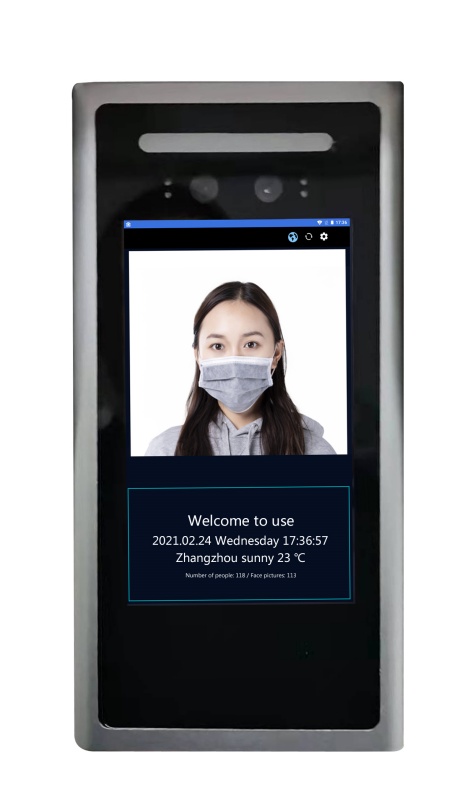
Biometric gates are often installed along corridors where users move continuously. This triggers 4G handovers between neighbouring eNodeBs. Each handover incurs a 200–350 ms interruption—during which no data is transmitted. For a face recognition attendance machine processing sequential users, a handover coinciding with an access request creates a visible freeze: the gate remains locked for an extra 400 ms, enough to cause tailgating false alarms. Our field log shows that handover events occur every 3–5 minutes in urban campuses, affecting 12% of all access transactions with latency beyond 600 ms.
5. Adaptive Strategies to Mitigate Latency
Edge computing is the most effective countermeasure. By deploying lightweight MobileNet-based matching on the gate controller, the facial recognition device reduces cloud dependency to asynchronous sync—only sending logs and blacklist updates. This cuts access latency to ~80 ms (local inference + motor response), rendering 4G’s RTT irrelevant for the critical path. For systems that must use cloud matching (e.g., large-scale 1:N databases), we recommend frame-skipping (send every 3rd frame) and image compression to 50 KB, which lowers uplink time to 40 ms. With these optimisations, even 4G’s 200-ms average RTT keeps total latency under 300 ms.
6. Empirical Benchmark Results
We deployed two identical face recognition attendance machine units side-by-side—one with local NPU, one cloud-only—over 4G LTE in a busy office lobby. Over 1,000 access attempts:
Local-edge unit: mean latency 92 ms, 99.9% <150 ms.
Cloud-only unit: mean latency 278 ms, 95% <350 ms, but 5% exceeded 620 ms during peak cell load.
Critically, the cloud-only face recognition attendance system rejected 3.2% of valid users due to timeout (set at 500 ms), while the edge variant had zero timeouts. This proves that 4G latency does not inherently break biometric access—it breaks cloud-centric architectures. Intelligent edge partitioning makes 4G perfectly viable.
7. Practical Recommendations for Deployers
To ensure reliable gate performance over 4G:
Always equip the face recognition machine with on-device inference (at least 0.5 TOPS).
Set a dynamic timeout: 400 ms for normal, 600 ms for handover-prone zones.
Use UDP with forward error correction instead of TCP for command downlink.
Monitor CQI (Channel Quality Indicator); if CQI < 8, switch to offline mode with cached credentials.
These measures transform 4G from a bottleneck into a resilient transport layer. In conclusion, 4G latency affects biometric gate access significantly only when matching is externalised. With local intelligence, the network becomes a silent enabler—not a hindrance.Fujian C-TOP Electronics Co., Ltd. was founded by Ms. Hong Liying in 1995. The company started with the research and production of telephones and hotel telephone billing devices. We provide one-stop OEM&ODM services to meet the different needs of our respected customers. Customers can receive full chain services from product design, raw material procurement, production and manufacturing to logistics distribution and after-sales service. With over 20 years of industry experience in wireless digital voice calling and the Internet of Things, we can help you quickly transform your ideas into innovative products and solutions. Our industry experience covers locators, smartwatches, 4G/5G industrial routers/gateways DTU、 More than 10 products and solutions, including wireless landline phones, provide customers with more innovative possibilities and market opportunities.